
Driven by regret over neighbor’s death, first-time filmmaker declares war on suicide

First published by The Japan Times
Rene Duignan is passionate about life − so much so, that he made an award winning film about it. Yet Rene is not a professional film-maker. He's an economist working for the Delegation of the European Union to Japan. The documentary, entitled "Saving 10,000 − Winning a War on Suicide in Japan," is a beautifully choreographed, impassioned plea to those considering suicide − to think again.
I met with Rene, ostensibly to understand why Japan has such a high suicide rate. That, unfortunately, remains an enigma. I did leave, however, with a deeper appreciation of the importance of having a purpose while living. For Rene, that purpose is to save lives. Rene's passion of purpose is so clearly expressed in the film that what might be considered a morbid subject by many is an inspiration to all.
The story began in 2007 when Rene's friend and neighbor was having 'problems'. She often brought her troubles to Rene. At first Rene lent her a sympathetic ear over tea. But as the visits became more frequent, Rene became impatient. Eventually, he stopped answering the door. "Frankly," says Rene, "I got tired of listening to her."
Rene got angry when, a couple months later, his landlord refused to fix a leak that left a horrible smell in the corridor. The smell got worse. Three or four weeks later, her corpse was discovered. His neighbor was only in her thirties at the time.
Raising rhetorical questions, Rene asks, "Where were her friends? Where were her family? How come they didn't know she was dead for a month?"
One could not help but to ask, "Where was he?" I did so. Rene replies, "I had chosen to ignore her. Maybe I could have persuaded her to get some help. I don't know if it was guilt, but there was certainly regret for coldly ignoring her. Regret was the driving force behind the project."
Rene already had the responsibilities of a full-time job, a Saturday teaching position and a family to care for. Still, he took on the huge challenge of making a documentary which he hoped would combat suicide. "Suicide is like a virus," explains Rene. "It travels down the media channels. So I thought, 'What if I could use the same channels in a different way?' "
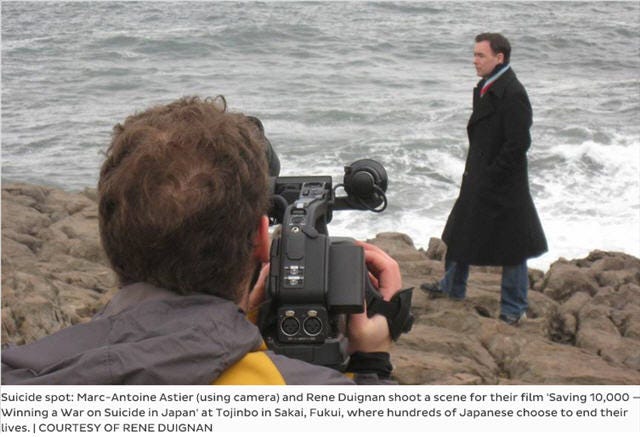
At first he approached documentary film-makers, but they weren't interested in helping him. "After all, who was I?" recounts Rene. Finally, Rene turned to one of his students from Aoyama Gakuin University where Rene taught business and economics every Saturday. Marc-Antoine Astier was a 22-year-old talented DJ and photographer, but he had no technical film-makings skills. Marc agreed to make the film. "Basically," says Rene, "we were starting from zero. We went down to the electronics shop and bought a camera. It was the first time for both of us."
It took Rene and Marc three years of exhaustive efforts to make the film. Rene worked lunch hours, evenings and weekends. In the first year, Rene conducted research. The second year, the two filmed. They edited the film in the third year. Marc did the filming and wrote the original music. In total they conducted 96 interviews and filmed over 100 hours of footage. Towards the end, Rene collapsed from exhaustion. He found himself in the hospital on a drip, where he made final edits of the 52-minute film in his head.
With the film now complete, Rene faced another problem: No place would show the film. He was beginning to think the whole effort a waste of time and money. Then, Linda Semlitz, Clinical Director at Tokyo English Lifeline (TELL) offered to help. TELL provides volunteer telephone hotline support to those in need of counseling. The film got its first viewing last September before an audience from TELL on Suicide Prevention Day. Sixty people attended the screening. When the film finished there was complete silence. In a defining moment, an old woman approached Rene and said, "That's not a movie, that's a weapon against suicide."
The film has since been screened at hundreds of events all over Japan. Rene has personally conducted over 70 movie-related events, including having made an eight-minute TEDxTokyo talk. At one screening that took place in the Parliament, 140 people attended. Then someone from the Suicide Prevention Office contacted Rene asking, "Can we have a copy of your DVD?" Then they asked, "Can you come in to talk to us?" Finally they asked, "Can we have another copy for the Minister." The film's message began to move from politicians, to bureaucrats, to NGOs and finally on to the public.
Requests for DVDs started pouring in from all over Japan. The Japan Association of Suicide Prevention asked for 600 copies of the DVD to give to its members. Taking 52 minutes to burn each DVD manually, poor Marc was making movies nonstop. When, one day, Rene reached into his pocket to give a spare copy to an old woman who had asked for one, Marc interjected, saying, "Please, stop giving them away!"
Rene was getting impatient. To save lives, he needed people to view the film, especially from within the Japanese population. NHK was dragging out its decision to release the film on national television. So Rene released the film on-line for all to download free from March of this year.
Soon the film started gaining acknowledgment from film festivals. In April, the film was screened at a film festival in Hollywood. Awards have been won in Hawaii and Indonesia. The on-line version started going viral − more than 150,000 people have downloaded it so far.
Rene talks about his feelings of regret that drove him to make the film. "Regret is a powerful emotion," says Rene. "It does not go away. It gives you a sense of desperation. It drives you relentlessly. It leaves you aching for a second chance that can never come."
Towards the end, the film cuts to an ocean scene on the cliffs of Tōjinbō. There, we are introduced to a retired police officer who used to patrol the cliffs where many people commit suicides. His job was to fish the bodies out of the sea. The constable, voluntarily, goes back to the cliff again in retirement. His self-assigned job − to extend a helping hand to those who, in a moment of desperation, consider taking their own lives. Rene (the film's narrator) says the constable has saved 290 people's lives on his watch (a number which since risen to over 400).
Like the constable, one feels that film-maker too has found his purpose in life through the extraordinary measures taken to save the lives of others. Going to extremes, Rene has made a breathtaking film that reaches out and touches everyone. I urge you to see this inspirational film.
Richard Solomon posts regular Beacon Reports at www.beaconreports.net. Rene Duignan works as an economist for the Delegation of the European Union to Japan. He also is a lecturer at Aoyama Gakuin University and an adjunct fellow at Temple
Suicide in Japan Through the Lens of the Film-Maker
Rene Duignan spent one year researching suicide in Japan to make his film, "Saving 10,000 − Winning a War on Suicide in Japan." These are the truths he uncovered:
§ The suicide rate is high in Japan, but Japan is not the world's leader − It ranked 10th in the world. South Korea and China have a higher suicide rate. The rate here is almost twice that of the United States, three times that of Spain, six times that of Singapore and twelve times higher than the Philippines.
§ The high suicide rate in Japan remains one of Japan's great mysteries.
§ Last year 27,858 people committed suicide in Japan. It was the first time in 15 years the number had dropped below 30,000.
§ 70% of those who commit suicide here are male and 30% are women. The suicide rate for Japanese women ranks 6th highest in the world.
§ The over 60s group accounts for one-third of all suicides. There is masked depression among the elderly, but nobody bothers to treat them. Often they are lonely and isolated individuals, unable to leave their homes.
§ Mental illness, such as depression, is the leading cause of suicide.
§ Pressure is the next leading cause. Overwork and bullying by a demanding boss often are to blame. Financial pressures may result from having taken on too much debt. Although the government has taken measures in recent years to prevent aggressive collection techniques, in the past indebted individuals and their families have been bullied and threatened for repayment.
§ Japan's insurance companies are indirectly complicit in incentivizing suicide by paying out in the event. To prevent such cases, life insurance companies first shifted to a one-year exemption period. The exemption was extended to two years, when it was found the suicide rate jumped on the 13th month. According to Rene, knowing that one's debts will be repaid and that a family can keep their home, makes suicide an attractive choice for a depressed person. "All you have to do is give your life," says Rene.
§ Many Japanese are desperate to talk, but find that there are too few who will listen. There are times when a person may need to call thirty times to get through to Inochi no Denwa, the Japanese suicide telephone helpline, because the lines are so busy. Of those that do get through, 70% - 80% are already on medication. It is obviously not working. Of the 27,858 that did commit suicide, almost 10,000 were already within the mental health system. 60% of callers to Tokyo English Life Line (TELL) are now Japanese.
§ There is a serious lack of talk therapy in Japan. Mental consultations are short, only 3-5 minutes. Therapy is not covered by health insurance and thus is too expensive for many people.
§ There is a tendency in Japan to institutionalize and overmedicate psychiatric patients according to experts interviewed in the movie.
§ Blue lights at train stations have reduced suicide by 80% at those stations.
Beacon Reports reveals Japan through the lens of thought leaders.