
A son echoes his father’s questions about identity

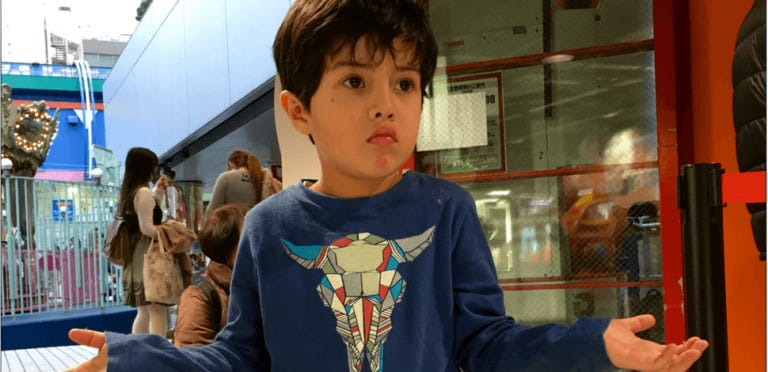
Noah's Question: “Papa, what does hāfu mean?”
In his 1971 hit single ‘Imagine’, John Lennon asks listeners to imagine living in a world where all mankind can live together in peace. Speaking recently before and at the behest of Her Imperial Highness Princess Takamado in Tokyo at an Asiatic Society of Japan event, Chuk Besher asks his audience to imagine the same. Chuk has come to talk about social diversity in Japan. The nation, he says, is more diverse and multicultural than most people would like to admit. With a little imagination, Japanese can come to accept others who look, think and act differently.
Chuk was born in Kobe in 1963 to stateless Russian refugee parents. He received Japanese nationality at birth, but to the wider audience he looks Western. Because he looks different from others, sometimes he feels excluded from the society he was born and grew up in. Chuk is even told by people he loves that he doesn’t fit in. “Being born and growing up in Japan, and often told that I am gaijin (not Japanese) made me want to know what is meant by ‘nihonjin’—the group of people I am often told I don’t belong to,” he explains. “Why am I welcome to live in, but do not belong to, the people in my own country?” he asks.
Last year Chuk’s eight-year-old son Noah approached his father. “Papa,” he asked. “What does “hafu mean?” Noah had been called hafu (half Japanese) by a second grade classmate at the local Japanese public school where he attended. It was the first question he ever asked his father about identity. Growing up, Chuk had also given much thought to his own identity and that of his countrymen. He even went to Columbia graduate school to study the subject. How was he to reply to Noah’s question?
Other than by appearance, Chuk is little different from other Japanese citizens. All are naturalized from intermingled people who immigrated to Japan from the Eurasian continent. Chuk’s maternal ancestors were Lutherans who fled religious persecution, moving from France to Germany and then on to Moscow. His paternal ancestors were likely Russian landed gentry who lived somewhere along the Russian and Polish-Lithuanian Commonwealth border during the 17th century. Chuk’s grandparents immigrated to Harbin, China for work and to escape persecution in Russia after the Empire collapsed in 1917. Each stayed, in order to avoid near-certain death.
His parents met in Harbin in the 1940s. Located in Far Eastern China, Harbin was mostly comprised of immigrants from the former Russian Empire. The couple married and gave birth to Chuk’s two older brothers, Misha and Sasha. They lived in a Russian community within the city, spoke Russian and attended Russian Orthodox Church. Chuk’s parents considered themselves ‘white Russians in exile’, even though they held Chinese Republican and Manchurian passports at various times in their lives.
When Mao’s communist government forced people of European descent to leave China, following the end of World War II in 1949, the family fled Harbin as refugees, traveling on Red Cross travel documents. They took with them two small children and Chuk’s grandmother, taking whatever possessions and valuables would fit into carry bags or into pockets of clothing. It took the family 4 years to get to Japan—moving across China to Hong Kong, crossing the sea to Australia, before finally arriving in Yokohama in 1953. The family settled in Kobe, where Chuk was born 10 years later.
For lack of a better explanation, Chuk considers himself to be Russo-Japanese. He grew up in a bicultural family, speaking Russian to his parents, grandmother, and two brothers, while speaking Japanese to his sister and nanny. Largely, he grew up just like other Japanese boys. For example, he attended a local Buddhist kindergarten and a Japanese public elementary school.
Chuk never quite fit in with the other children. Mostly he was treated with kindness by his fellow countrymen. Other times he was picked on, usually by older kids. His mother wisely enrolled him in the local police Judo class to learn self-defense, discipline and self-respect. The class helped settle disputes. Once he pinned down a bully, shouting, “I am not a gaijin! Do you want to be friends or do you want to die?” Wisely, the bully chose the former.
Once in the third grade, Chuk got on a public bus in Kobe, greeting the driver in a traditional Japanese way. Astonished by the boy’s unusual appearance and behavior, the driver responded, “You speak perfect Japanese. How cute!” A few stops later a Japanese looking girl, probably in her teens, got on the bus and fumbled with her change. The driver, irritated as he became aware that she spoke little or no Japanese, insulted the girl. “Are you Korean, Chinese or what?” he shouted. She started to cry. Nobody on the bus said a word. Chuk felt ashamed and angry. He inferred from that experience that people can be uncomfortable when meeting others who look and act different. According to Chuk’s own research, about one-third of the people from Kobe are of Korean or Chinese descent.
Whenever Chuk came home upset about having been called a gaijin on the street or at school, his nanny Ms. Chiyo Hirata, would console him. She would say, “Ignore them. They don’t know what they are telling you. You are more Japanese then they are. You are even more Japanese than I am,” citing as justifications Chuk’s good education and better language skills.
Hirata provided Chuk an early window into Japan’s not-so-obvious social diversity. She came from the Goto Islands in Nagasaki. When she returned home on vacations Hirata would often say, “kuni ni kaerimasu” (I’m going back to my country). In public, she would greet new acquaintances by asking them, “What kuni (country) are you from.”It was the accepted way of asking where in the Japanese archipelago a person came from, says Chuk. The greeting, she told him, was a vestige of pre-Meiji Japan, when travelers referred to their home as han (feudal domain), each having its own ruler, distinct culture, creeds, loyalties, language or dialect.
Late 19th Century Meiji period rulers began passing laws to unify inherently diverse regional populations. To create a single state of loyal subjects, they enacted Nationality Laws—the same laws, for example, which granted citizenship to Chuk and other children born to stateless parents. Modern-day policymakers continue to describe Japan as having “one nation, one civilization, one language, one culture, and one race,” as did gaffe prone minister Taro Aso, in October 2005. Such myths may be a unifying source of national pride and identity, but they are best oversimplifications. At worst they are divisive.
Japan's Department of Social Education, Ministry of Education (now called MEXT) more accurately described the myth of Japan’s supposed mono-ethnic culture in their 1942 paper titled, ‘The Road to Social Integration’: “The Japanese people are not tanichi minzoku (monoethnic). On this topic, we came to be ‘one people’ from a strong belief under the process of sumeragi-ka (imperialization). We have all been naturalized and intermingled from many peoples—indigenous, immigrants from the continent, and people from other places.”
In fact nobody living in the Japanese archipelago is Japanese-Japanese. Stone age hunter-gatherers from the Eurasian continent started arriving in Japan as early as 35,000 years ago, during the last ice age. They crossed to Japan on foot over land bridge until about 20,000 years ago, when the polar ice caps melted and the sea levels rose to separate the archipelago from the continent. They also likely came by boat traveling along the chain of islands linking Taiwan, Okinawa and Kyushu.
Alas, humankind may not have evolved sufficiently for people to accept this broader view. People still treat others based on how they look, speak, and behave. They strive to define themselves as being part of the in-group, denying the legitimacy of other people. Political leaders continue to spin narratives which unite one group of people, with sometimes violent consequences against other groups.
Chuk closed his talk by returning to Noah’s question, “Papa. What does “hafu mean?” Noah reasoned, “You and Mama are both Japanese, right? Am I not Japanese too? Am I not furu (full)?” After a pause, Chuk responded: “When they ask, ‘Are you hafu?,’ tell them, ‘Yes, you are hafu. Everyone is hafu, because everyone is half Mama and half Papa,’” he advised. His answer gives hope to the next generation of truly global citizens. If enough people join Chuk and his family, perhaps someday we can all live in peace, as John Lennon imagined.
Chuk’s Ancestral Past: The Long and Winding Road
Chuk’s mother Helen (Elena, in Russian) was born in 1921 in Blagoveshchensk, a town located in the Soviet Union’s Far East, close to the Chinese border along the Amour River. Her father, Alexander, was a Chemist associated with the Russian Imperial government. Helen’s mother, Agrippina, was a nurse in Blagoveshchensk who worked at the Russian army hospital. Alexander fled St. Petersburg, via Blagoveshchensk, married Agrippina, and then fled with the family to Harbin, escaping persecution. Helen grew up in Harbin. There, she went to Russian and international schools, where she met and married Joseph (Ioseph in Russian).
Joseph was born in Harbin, in 1919. Joseph’s father was a Moscow educated engineer who worked for the Trans-Siberian Railway. He was later posted to Harbin to work on the railroad before the Russian Revolution. He remained there to avoid persecution, due to his Imperial Russian ties. Joseph was adopted by his aunt when he was aged seven years old, after his father died. He never knew his mother, only once referring to her as “some woman who showed up at his father’s funeral and caused a commotion”. After marrying Helen and graduating from college, Joseph worked as a journalist writing about the arts. Later, he became a tradesman. He traveled to Japan in the 1930s as a journalist and on business, developing friends and an interest in the country. Joseph was determined to make Japan his new home, after the Beshers were forced to flee Harbin for their lives.
Chuk’s Biography
Chuk is the youngest of 4 children, separated by 15 years in age from youngest to eldest. His eldest brother, Misha, is professor of cultural anthropology at a university in Paris. His second eldest brother, Sasha, is a writer living in Columbia. His sister, Caterina, is a retired Banker living in Berkeley, California.
When Chuk was 14 years old in 1976, the family moved to San Francisco, where most of his siblings had then settled. Speaking little English on arrival, Chuk experienced a whole new set of challenges adapting to US culture, attending a private Junior High School.
Later, he obtained a liberal arts degree at St. John's College in Annapolis Maryland, where he studied the Classics—Greeks through to the 20th Century thinkers in every genre of philosophy, maths and science. On a Watson Fellowship, he spent two years traveling through Russia and Japan tracing both countries attitudes towards foreigners. Chuk holds a graduate degree from Columbia University’s School of International and Public Affairs in East Asian Studies and Communication.
Today Chuk works for Gree in Media and Advertising. His career spans politics, marketing, broadcasting, and government relations. Most recently, he was in charge of communication planning for the Olympics and FIFA World Cup as well public affairs and sustainability at Coca-Cola Japan. Chuk lives in Tokyo, with his wife Yuki, and two sons Noah (8), and Luka (6).
Beacon Reports reveals Japan through the lens of thought leaders. Subscribe free!